You have probably heard the pitch by now. Adopt AI, automate your workflows, and scale your firm without adding headcount. It sounds like the answer to everything slowing you down: the intake backlog, the document mountain, the attorneys buried in tasks that do not require a law degree.
But here is what nobody is telling you: AI is not a fix. It is a force multiplier. And if what you are multiplying is a broken process, you are not going to get efficiency. You are going to get faster mistakes, more liability exposure, and a team that is more overwhelmed than before.
The firms winning right now are not the ones moving fastest with AI. They are the ones moving smartest, fixing their foundations first, then layering in technology where it actually earns its place.
What Are AI Agents in a Legal Context?
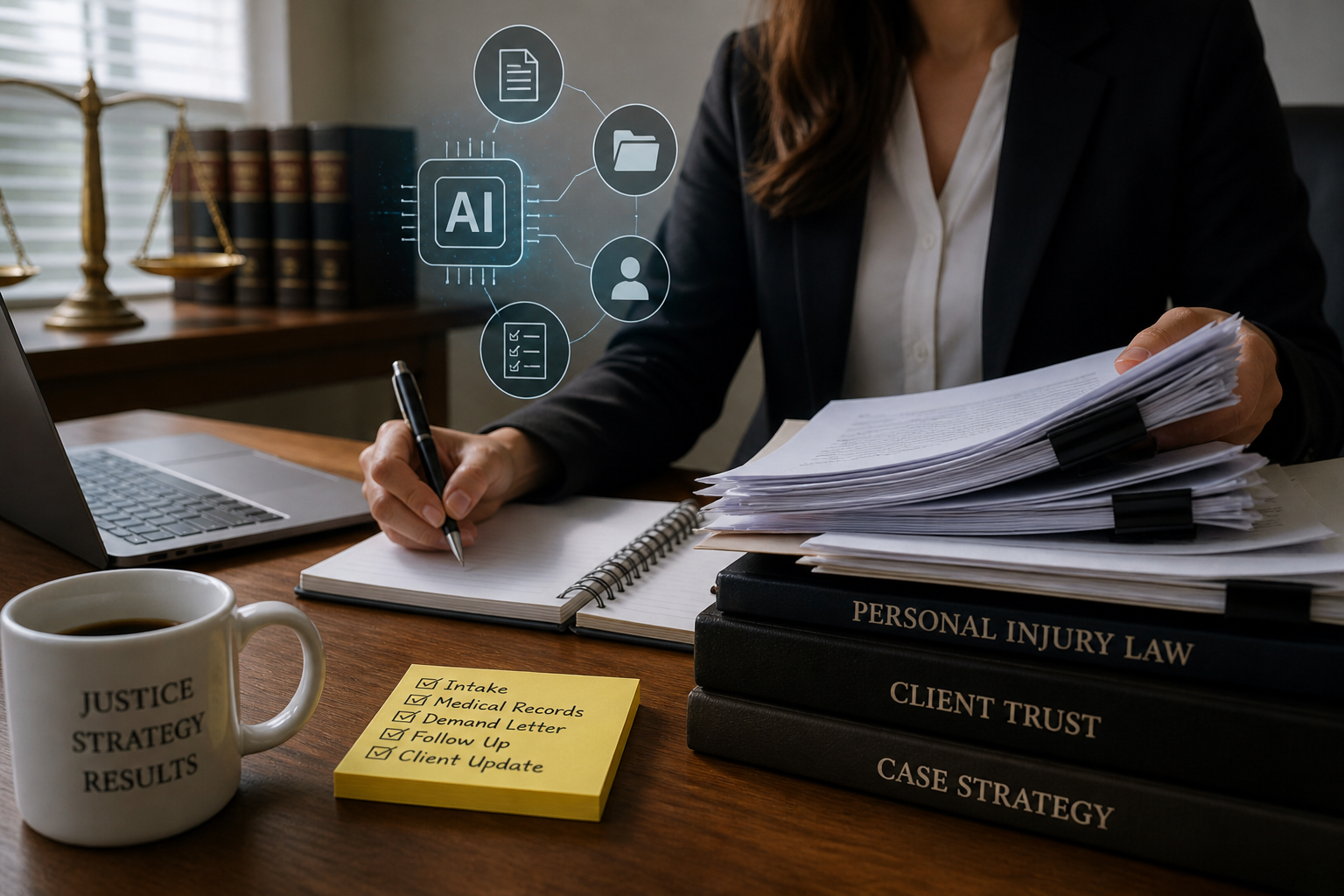
The term gets used loosely. In practice, an AI agent is software that can execute a sequence of tasks autonomously. Not just respond to a prompt, but take action based on inputs, rules, and prior outputs. In a personal injury firm, that looks like:
- Intake chatbots that gather case information and qualify leads around the clock
- Document automation tools that draft demand letters, medical summaries, and correspondence
- Case summarization systems that digest large record sets and surface what matters
- Follow-up automation that sends reminders, status updates, and document requests
- Internal knowledge tools that give staff instant access to SOPs and templates
However, the critical distinction most vendors skip over is that task automation does not equal decision-making. AI can execute well-defined, repeatable processes reliably. It cannot evaluate whether a settlement is strategically sound, empathize with a grieving client correctly, or determine when the facts of a case do not add up. Those are judgment calls, and they require humans.
What Actually Works
Note Taking
Personal injury leads don’t keep business hours, and neither does the need to capture critical case details. An attorney meeting with a prospective client after a late-night accident can’t afford to rely on memory alone. AI-powered note-taking tools like Fathom automatically record, transcribe, and organize conversations, ensuring that no detail slips through the cracks. Instead of scrambling to reconstruct facts days later, firms can instantly access structured notes that highlight key case information and action items. For practices losing efficiency because important details were missed or forgotten, this changes the math on case preparation and client service.
Document Drafting and Medical Record Summarization
Reviewing hundreds of pages of medical records before drafting a demand letter is necessary work that does not require an attorney to initiate. AI tools trained on legal and medical content can extract treatment timelines, flag inconsistencies, and produce structured summaries in minutes. The attorney still reviews and signs off. What changes is how long it takes to get there.
Administrative and Follow-Up Workflows
Appointment reminders, CRM updates, document request follow-ups, and client status notifications. These are high-volume tasks that require staff time without requiring legal expertise. Automating them frees your team for work that actually requires human skill: relationship management, complex coordination, and judgment calls.
What Breaks
Hallucinations and Legal Risk
AI language models generate text that sounds authoritative even when it is wrong. In a legal context, that is not a minor inconvenience. It is a malpractice and ethics problem. AI systems have produced citations to cases that do not exist, quoted statutes inaccurately, and generated timelines with material errors. The attorney signs the document. The attorney is responsible for what it says. Every AI-generated work product that touches a legal matter needs a defined human review checkpoint before it goes anywhere.
Emotional and Contextual Failures
Personal injury clients are frequently in pain, under financial stress, and navigating a system they do not understand. The quality of communication they receive from your firm shapes their trust, their cooperation, and their likelihood of referring others. AI cannot read emotional context. It cannot recognize that a client is anxious, not disengaged. Placing AI in direct client-facing roles without human oversight is one of the most common and most damaging mistakes PI firms make with automation.
Compliance and Data Privacy Risks
Not every AI platform is built to handle confidential legal data. Before deploying any tool that touches client information, your firm should confirm SOC 2 Type II certification, understand the vendor’s data retention and deletion policies, and verify that your data is not being used to train their models. These are not optional questions. They are professional responsibility requirements.
What Still Needs Humans
There is no version of a personal injury firm that runs without people who can think, empathize, and be accountable. AI is not replacing these roles. When used correctly, it gives the people in these roles more time to do them well.
No tool can replace the judgment it takes to evaluate a case, build a strategy, or decide when to settle.
Client trust is built through human relationships. Especially in PI, where clients are often at their most vulnerable, that human connection drives outcomes and referrals.
Final review and accountability for any AI-generated work must sit with a licensed professional. Full stop.
The Irreplaceable Value of Your Support Team
While AI handles the data, the true “operating system” of a firm remains its specialized staff. Despite the rise of AI, these roles have become more critical, not less:
- Paralegals & Case Managers: AI can summarize a medical record, but a Case Manager understands the implications of a specific injury on a client’s unique life. They bridge the gap between “data” and “damage,” ensuring the narrative of the case is human and compelling.
- Intake Specialists: A bot can check boxes, but an Intake Specialist listens for the tremor in a caller’s voice. They provide the immediate emotional validation that turns a traumatized lead into a loyal client.
- Marketing Specialists: AI can generate generic copy, but it can’t build a brand that resonates with a local community. Marketing experts ensure your firm’s voice remains authentic and stands out in a sea of AI-generated noise.
- Executive Assistants: They serve as the “human filter,” managing the nuances of an attorney’s schedule and prioritizing the high-level tasks that AI simply cannot categorize by importance.
In short, AI handles the process, but these professionals handle the purpose.
The Model That Actually Scales
The firms seeing real results are building hybrid operations. AI handles high-volume, repeatable tasks, and skilled human staff handle everything that requires judgment, nuance, or relationship.
AI captures the intake lead. A trained specialist reviews and qualifies it.
AI prepares the first draft, and attorneys review and approve it and provide any additional statistical information that will add value to the case.
Automated systems provide a solid workflow. A person takes care of anything that needs empathy or a choice.
Don’t just make your law firm faster; make it smarter too.
Companies that are really gaining results from AI aren’t the ones that automated everything in one night. They are the ones who established the right base first: clear workflows, trained people, and technology that helps people make decisions instead of taking them away.
That is where Stafi comes in.
We help personal injury firms build the human infrastructure that makes AI actually work. The intake specialists, legal assistants, and operations professionals who keep cases moving, clients informed, and attorneys focused on what only they can do.
Ready to build a firm that scales without breaking?
Set up a strategy call with Stafi, and we’ll help you figure out what to automate, what to delegate, and what should always stay with your team. Schedule a call here or call our 24/7 line 786-981-5619.
About the Author
 Raquel Gomes
Raquel Gomes, Co-Founder and CEO of Stafi, has shaped the company through a holistic, empathy-driven approach. With her background in psychology and business, she’s built a culture where legal representatives lead with understanding, helping law firms grow with support that feels human.