
Discover why 67% of legal leads call outside business hours and how law firms are losing six figures annually by not answering. Learn the proven solution that converts after-hours calls into signed retainers.
The Best Feedback Always Comes From In-Person Gatherings
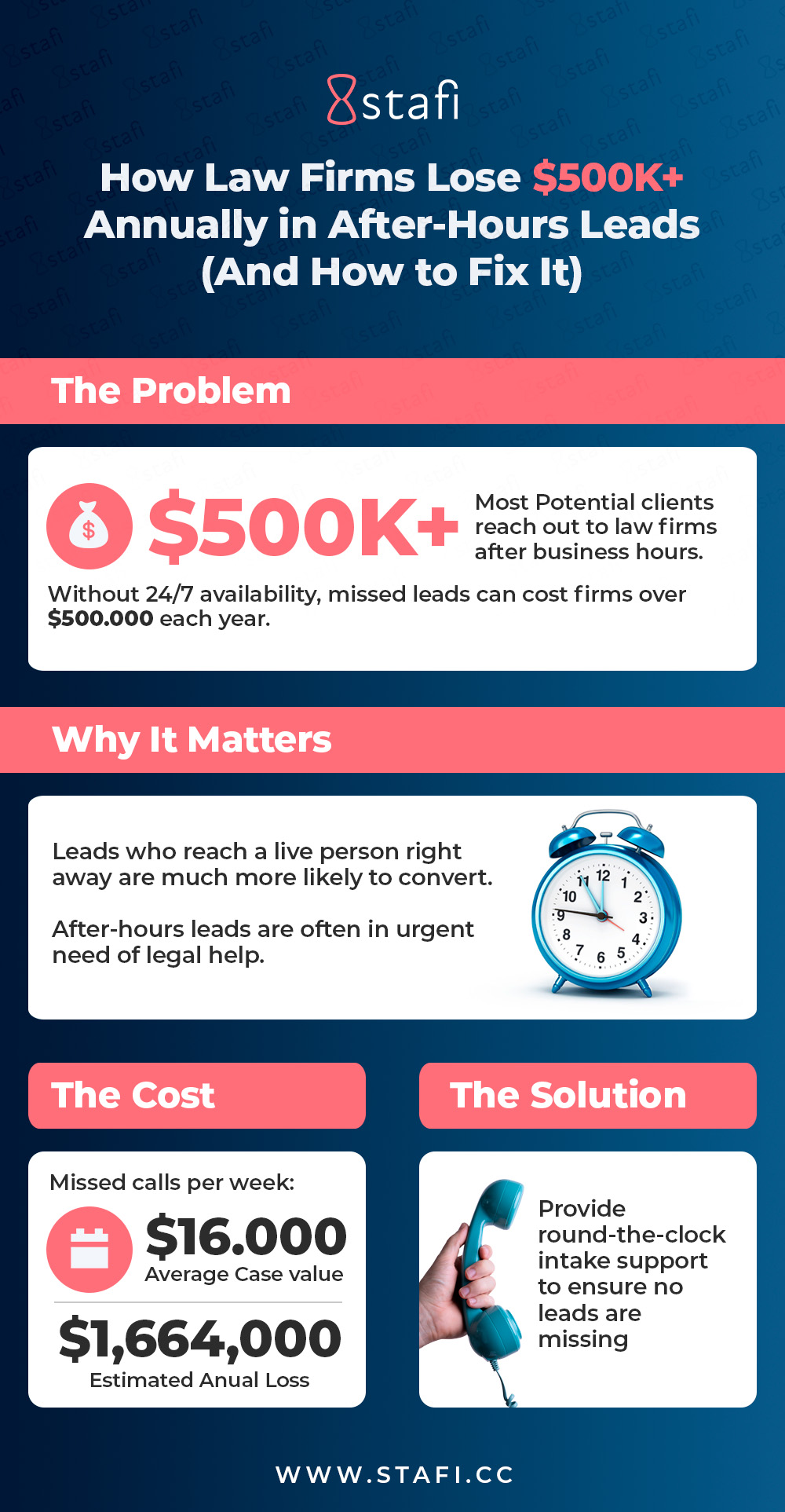
During the first week of November, I was at a legal conference speaking with firm owners about growth, systems, and the realities of running a productive law firm. In between sessions, an attorney approached our booth. As our conversation went on, he sounded like someone who had been carrying the weight of his entire firm on his shoulders for a long time. He wasn’t big on small talk. What resonated the most was when he almost apologetically said, “Raquel, we get about ten after-hours and weekend calls every week. And we miss almost all of them.” I asked him what his average case value was, and when he told me $16,000, I pulled out my notebook. We did the math together. If even two of those missed calls were qualified leads, just two out of ten, that’s $16,000 times two times all 52 weeks of the year. He watched me write the number out slowly. $1,664,000. Almost two million dollars slipping through the cracks, not because the cases weren’t there, not because the marketing wasn’t working, but simply because no one picked up the phone.
He didn’t look shocked. He looked confirmed. It was as if he finally saw in writing what he’d been feeling for years. The real revenue leak in his firm wasn’t effort or talent. It was availability.
The After-Hours Reality Most Law Firms Ignore
I have heard versions of his story at nearly every event I have attended. Attorneys often assume their clients call during business hours, but data across the legal industry tells a very different story. Most potential clients reach out in the evenings, on weekends, or at the exact moment their crisis hits. And because they are scared or overwhelmed or desperate for answers, they don’t just need someone to pick up the phone; they need someone who knows how to listen with empathy, answer their questions confidently, and influence them to sign the retainer on that very first call.
Here’s the problem: there are plenty of after-hours services that answer the phone. But they are just a glorified voicemail. They take a message, you call back the next day to try to win the deal, and by then it’s usually too late. That’s not what I’m talking about here. I’m talking about trained legal intake specialists who actually convert calls into signed cases, not just into callbacks you have to chase.
Why After-Hours Legal Leads Convert 20X Faster With Immediate Response
Research supports this: leads who reach a live person within five minutes are more than twenty times more likely to convert. That means that even if you call someone back at 9 AM the next morning, there’s a strong chance they’ve already signed with someone else. It’s not because they didn’t want you. It’s because they needed someone right away.
When you run the numbers honestly, the pattern becomes impossible to ignore. In a mid-sized personal injury firm, it’s common to see around 150 leads a month. If roughly two-thirds of those calls come after hours, that’s around one hundred people trying to reach the firm when no one is available. Even if only a small portion of those are viable cases, the annual revenue impact quickly rises into six or seven figures. Smaller firms feel it just as strongly. Losing five $10,000 cases each month adds up to $600,000 a year. No marketing strategy can outspend that kind of loss.
Why Voicemail, AI Chatbots, and Basic Answering Services Don’t Work
The part no firm owner likes to say out loud is that the usual solutions don’t actually fix the problem. Voicemails don’t create a connection. Next-morning callbacks are too slow for clients in crisis. On-call rotations exhaust attorneys who are already stretched thin. AI chatbots and automated systems feel cold and impersonal when someone needs human empathy most. Basic answering services take messages but rarely build trust or qualify leads in a meaningful way. They operate like human voicemail with slightly better manners. None of these approaches converts calls into signed retainers, which is what actually matters.
What High-Converting After-Hours Legal Intake Actually Looks Like
The firms that grow steadily, the ones that feel balanced, calm, and predictable, treat after-hours intake as a true extension of their practice. Not as an add-on or something that will get handled later. They make sure a trained intake professional answers the phone at 7 PM, 10 PM, or 2 AM if needed. They make sure callers can speak in Spanish if that’s the language they feel safest in. They make sure the initial conversation feels like the start of a relationship, not a transaction.
And when that happens, something changes. Not because the firm becomes bigger overnight, but because it becomes reachable in the moments that matter most.
How to Implement 24/7 Legal Intake Support Without the Headache
Implementing round-the-clock legal intake support isn’t the logistical challenge many imagine. The systems connect to a firm’s existing tools, including calendars, case management software, scripts, and workflows. It doesn’t require rebuilding the entire operation. It simply fills the gap between when clients decide to call and when the firm is usually available to answer. The difference is noticeable within the first month. More retainers get signed. Fewer leads slip away. Attorneys feel less pressure to monitor their phones outside working hours.
The Bottom Line: Stop Losing Revenue to After-Hours Unavailability
The truth is that law is not a nine-to-five profession, because people do not experience emergencies on a schedule. As long as that remains true, which it always will, the firm that answers at the exact moment a client needs help is the firm that earns the case.
So the question is not whether after-hours leads matter. They do. They always have.
The real question is, how many more can you afford to lose?
Let’s meet and find out if Stafi can help your firm take ownership of your after-hours game.
About the Author
 Raquel Gomes
Raquel Gomes, Co-Founder and CEO of Stafi, has shaped the company through a holistic, empathy-driven approach. With her background in psychology and business, she’s built a culture where reps lead with understanding, helping law firms grow with support that feels human.