There is a moment most personal injury firm owners know well.
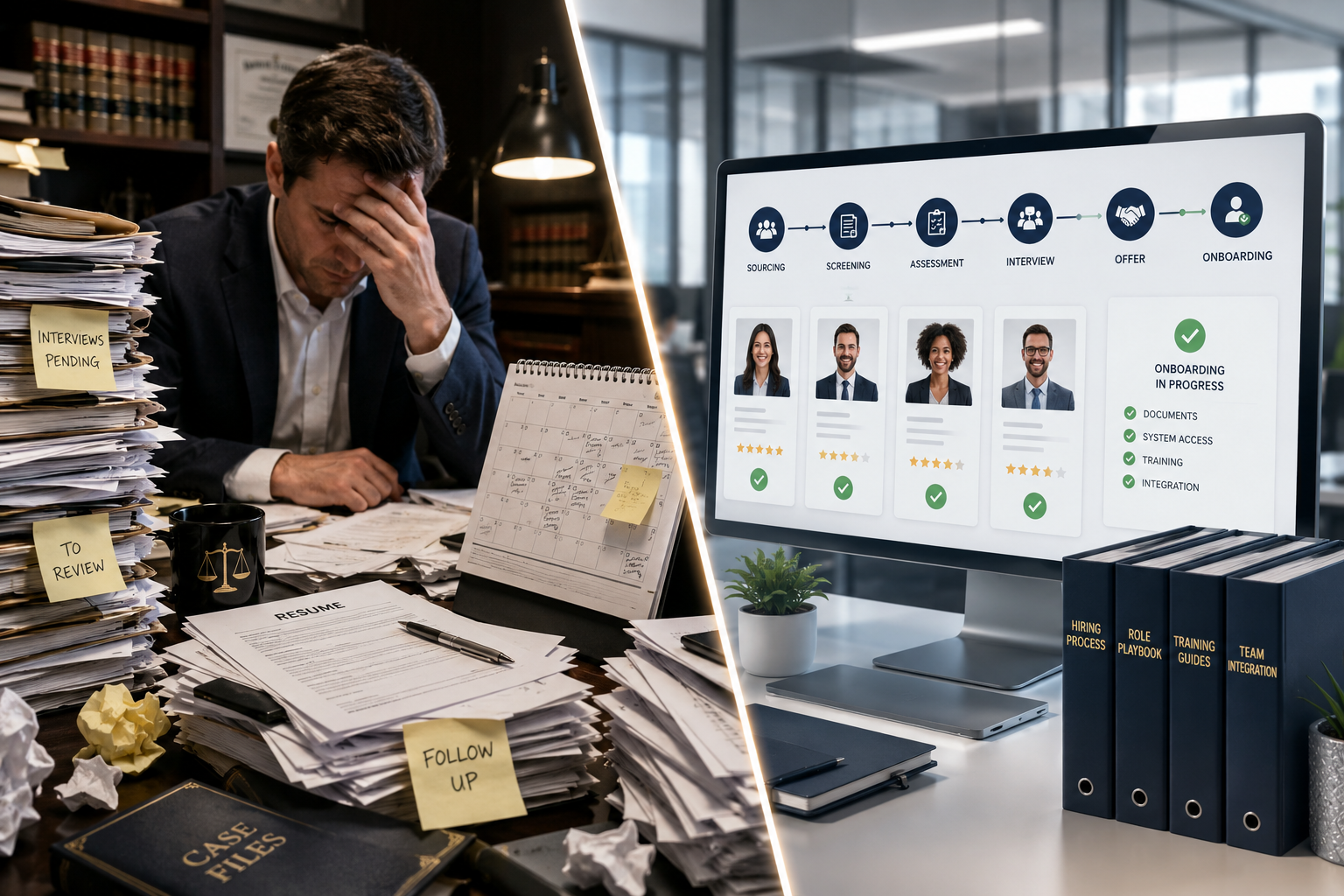
You are sitting across from a candidate who seems decent. Not great. Decent. They have the right experience on paper, they interviewed reasonably well, and you are 90% sure they are not the person you actually need. But you have already spent five weeks looking, your intake is understaffed, and leads are piling up. So you make the hire anyway and hope for the best.
Three months later, you are back at square one.
This is not a story about one bad hire. It is a story about a broken process that plays out across personal injury firms of every size, every year, on repeat. Understanding why it happens, and what the best-run PI firms do instead, is the first step to getting off the carousel.
Why Legal Hiring Takes So Long in Personal Injury Firms
Before blaming the candidates or the job market, it helps to understand what the hiring process actually involves at a structural level. Most PI firm owners underestimate how many steps sit between “we need someone” and “they are performing at full capacity.”
A standard legal support hire in a personal injury firm moves through seven distinct stages:
- Application and Job Posting (14 days): Writing an accurate job description, choosing where to post it, and waiting for enough applicants to build a pool worth reviewing. Most PI firms post on general job boards and receive applications from candidates with no legal experience, let alone personal injury experience.
- Resume Screening (7 days) Sorting through volume to find candidates who meet the minimum requirements. In a busy PI firm, this task falls on whoever has the least full plate, which is rarely the right person to be making staffing decisions.
- Assessment (7 days) This is where most PI firms cut corners or skip the stage entirely. The goal is to understand whether a candidate has the natural traits needed to thrive in the role. Evaluate how a candidate thinks, communicates, pays attention to detail, and focuses on execution.
Those traits need to be established before the assessment begins, because this will orient which are deal breakers for the position. - Background Check (7 days) This one cannot be rushed, which is exactly what makes it frustrating. You have found someone you like, the team is ready to move, and now you wait. One flag, one slow response from a former employer, and the whole timeline slides back another week. Skipping it is how firms end up with the wrong person in a client-facing role.
- Interviews (7 days) By now, you have spent three weeks on this hire, and the entire process lands on your calendar. Screening calls, behavioral rounds, and final interviews all require scheduling and follow-up that falls on whoever already has the least bandwidth. Ideally, different people should interview the candidate at different stages to bring multiple perspectives and reduce blind spots. The irony is that the most important stage is usually the most rushed because everyone just wants it to be over.
- Job Offer (7 days) You have made your decision, and it can still fall apart. Verbal offer, written offer, negotiation, confirmation of start date, and reporting structure. Most firms underestimate how much back and forth happens here, especially when the candidate is still talking to other firms. A slow offer is a lost offer.
- Pre-Onboarding (7 days) Paperwork preparation, systems access, equipment setup, training preparation, and communication to the existing team.
Add those stages together, and you are looking at a minimum of 7 to 8 weeks from the moment you decide to hire to the moment someone is sitting in the seat. And that timeline assumes everything goes smoothly: no candidate falls through, no background check flags, no offer negotiation stalls.
In reality, most PI firms go through this process two or three times before finding someone who works out long-term.
The Bias Problem Nobody Talks About in Legal Hiring
Beyond the timeline and the cost, there is a third reason personal injury firms struggle to hire well: unconscious bias in the selection process.
Research shows that hiring managers are often influenced by factors entirely unrelated to job performance. In a legal environment, this often means the candidate who interviews most confidently gets selected over the candidate who would actually perform best in the role.
This matters enormously in personal injury intake, where the skills that drive performance are almost invisible in a standard interview. Empathy under pressure. Clarity with distressed clients. Urgency without aggression. Consistency across a high volume of calls. These are qualities you cannot assess in a 30-minute conversation. You need structured behavioral testing, role-specific assessments, and a process built to surface them.
Most PI firms do not have that process. They have an interview and a gut feeling.
Research also shows that homogeneous hiring teams produce homogeneous results. Firms that evaluate candidates through the same lens every time, using the same informal criteria and instinct-based judgment, consistently underperform firms that use structured, data-driven selection methods. Diverse teams that bring different cognitive approaches and communication styles produce better decisions, better client service, and significantly lower turnover.
The firms getting legal hiring right are not necessarily smarter or better resourced. They are more systematic.
What the Best Personal Injury Firms Do Differently
The PI firms that consistently hire well, retain staff longer, and maintain high intake performance share a set of common practices that separate them from the majority.
They hire before the breaking point. The best-run PI firms treat staffing as a continuous operational function rather than an emergency response. They identify gaps before the team is overwhelmed and begin the process while they still have time to be selective. Reactive hiring is almost always expensive.
They define the role with precision before posting it. Top PI firms know exactly what they need before they start looking. Not just the job title, but the specific tasks, the required temperament, the pace of the role, and the skills that will determine success in a personal injury environment specifically. A vague job description attracts vague candidates.
They assess for PI-specific qualities, not just general competence. Legal experience doesn’t automatically make someone great at personal injury work.
In PI, who you are often matters more than what you’ve done. Empathy, persistence, and the instinct to fight for people, those aren’t skills you learn. You either have it or you don’t.
Systems, scripts, and workflows can be taught. Empathy, urgency, emotional steadiness, attention to detail, and clear communication under pressure are harder to train. The best firms look for the soft skills that help someone thrive in a high-volume, client-facing environment, because without those traits, even an experienced hire may struggle to excel or stay in the role long term. The best firms use assessments that surface empathy, urgency, communication under pressure, and cultural adaptability because these are the four that have the greatest impact.
They onboard with structure and SOPs from day one. Strong onboarding starts with Standard Operating Procedures. The best PI firms do not hand a new hire a login and expect them to figure it out. They have documented processes, defined responsibilities, and a structured first 30 to 90 days that answer the new hire’s most important question before they even have to ask it: What exactly is expected of me, and how do I do it well?
The data backs this up. Firms with strong onboarding see up to 82% better retention and 70% higher productivity compared to firms that hand someone a login and hope for the best.
And when that new hire is an offshore remote team member, onboarding matters even more. The best PI firms do not treat remote staff as outsourced help sitting somewhere off to the side. They bring them into team meetings, keep them informed on firm priorities, copy them on the conversations that matter, and invest in their growth the same way they would for someone sitting three desks away. Because the moment an offshore remote team member feels like an outsider, you have already started losing them.
They integrate remote staff as full team members. The rise of remote legal staffing has created enormous opportunities for PI firms to access talent they could not find or afford locally. But remote staff only perform at their full potential when they are treated as genuine members of the team: included in meetings, kept informed of firm priorities, and given the same investment in development and communication as in-office staff.
They invest in their people after hiring, not just before. Turnover in legal support roles costs firms an average of 75% of the employee’s annual salary to replace. The firms with the lowest turnover are the ones that continue to invest after the hire is made. Coaching, skill development, clear career pathways, and consistent feedback are not nice-to-haves. They are the reason people stay.
The Real Cost of Doing Nothing Different
Most PI firm owners already know their hiring process is broken. They feel it every time a good candidate goes elsewhere because the process took too long. They feel it when they make a hire under pressure and spend the next three months managing the fallout. They feel it when they look at what their intake conversion rate should be and compare it to what it actually is.
The personal injury law market reached $61.7 billion in revenue in 2025 and is projected to surpass $63 billion in 2026. More than 164,000 PI attorneys across 60,000 firms are competing for that opportunity. The firms winning market share are not always the ones with the most aggressive marketing. They are the ones with the operational infrastructure to capture and convert the leads their marketing generates.
Staffing is that infrastructure. And a broken hiring process is a leak in the foundation that no amount of marketing spend can fix.
How Stafi Helps Personal Injury Firms Solve This Problem
This is where Stafi comes in.
Stafi is a remote legal staffing company built specifically for law firms with deep expertise in personal injury practices.
The Stafi Index is our proprietary matching system that brings structure, consistency, and data to a hiring process that too often depends on urgency and instinct.
Because hiring is what we do every day, our process is already active, refined, and supported by a consistent talent pipeline. For most firms, once the engagement begins and the role is clearly defined, we can typically present qualified candidates within 1 to 3 weeks, depending on current client demand and waitlist availability.
Here is what the Stafi process looks like.
Every month, Stafi reviews more than 1,500 resumes. From that pool, approximately 1,000 candidates move into a multi-stage assessment process designed to evaluate more than technical qualifications alone.
Candidates are assessed on English language proficiency at C1 level, personality and behavioral traits, communication skills, cultural alignment, soft skills, and technical capabilities relevant to law firm operations.
From that group, only 20 candidates are selected to enter hands-on training and asynchronous education through Stafi Legal University across specialized tracks: intake and people-facing roles, legal support, administrative operations, and marketing.
Ultimately, only 15 candidates are presented to client firms.
The purpose of this process is not speed for the sake of speed. It is consistency, predictability, and long-term alignment between the candidate, the role, and the operational demands of a law firm.
That is a 1% acceptance rate.
By the time you review a Stafi candidate, they have already been background checked, assessed, trained in PI-specific skills, and matched to your firm based on both capability and cultural fit. You are not starting from a stack of resumes. You are choosing from a curated shortlist of professionals who are ready to contribute from day one.
Stafi places four roles most frequently in personal injury firms because these are the four that have the greatest impact on intake performance, case throughput, and attorney capacity:
Intake Specialists: who qualify leads, convert calls into consultations, and follow up with unresponsive prospects so your marketing investment actually becomes signed cases.
Case Managers: who handle medical record requests, insurance correspondence, client updates, and document coordination so attorneys stay focused on legal work.
Executive Assistants: who manage scheduling, email, administrative follow-up, and operational coordination so firm owners can lead instead of administer.
Marketing Assistants: who handle social media, content, review management, and campaign support so the firm stays visible without the owner doing it manually.
Each of these roles frees more than 10 hours per week for firm leadership. Four strategic hires return 40 or more hours per week to attorneys and owners. At a $500-per-hour owner value, that is $20,000 a month in recaptured capacity.
All Stafi representatives are bilingual in English and Spanish, and Stafi Live provides 24/7 bilingual intake and receptionist services for PI firms that need coverage outside business hours. And Stafi’s client success team and coaching infrastructure stay involved after placement to make sure every hire actually works, not just on paper but in practice.
Frequently Asked Questions
How quickly can Stafi place a legal intake specialist for my PI firm? Stafi runs its vetting and training process continuously, so firms are not starting from scratch once they decide to hire. Once the role is clearly defined, Stafi can often present qualified candidates within 1 to 3 weeks, depending on the role, candidate availability, and demand. During high-demand seasons, some clients may join a waiting list so the match is made correctly instead of being rushed.
Do Stafi candidates have personal injury experience specifically? Yes. Stafi University trains candidates in PI-specific skills, including intake qualification, medical record coordination, insurance communication, and case management support, before they are ever placed with a firm.
What if the placement is not the right fit? Stafi’s client success team works with the firm directly if adjustments are needed. You are not left to manage the problem alone.
Does Stafi offer bilingual intake specialists? Yes. All Stafi representatives are bilingual in English and Spanish, which is particularly valuable for PI firms serving diverse client populations.
What is Stafi Live? Stafi Live provides 24/7 bilingual intake and receptionist services staffed by legally trained professionals. PI leads who call after hours are captured, qualified, and scheduled rather than lost to voicemail.
Ready to Stop the 7- to 8-week cycle?
The firms that scale sustainably are not the firms constantly scrambling to hire under pressure. They are the firms that build operational systems before growth becomes chaos
If you are running a personal injury firm and you are tired of hiring under pressure, training people who do not stay, and watching intake performance fluctuate with every staffing change, Stafi was built to solve exactly this.
We match PI firms with pre-vetted legal intake specialists, case managers, executive assistants, and marketing professionals who are ready to contribute from day one. No seven-week searches. No reactive hiring. No starting over every 90 days.
Book a free strategy session and find out what the right hire, matched the right way, could mean for your firm’s intake performance, your caseload, and your time back. Or call us on our 24/7 line: (786) 891-5619.
About the Author
 Raquel Gomes
Raquel Gomes, Co-Founder and CEO of Stafi, has shaped the company through a holistic, empathy-driven approach. With her background in psychology and business, she’s built a culture where legal representatives lead with understanding, helping law firms grow with support that feels human.