
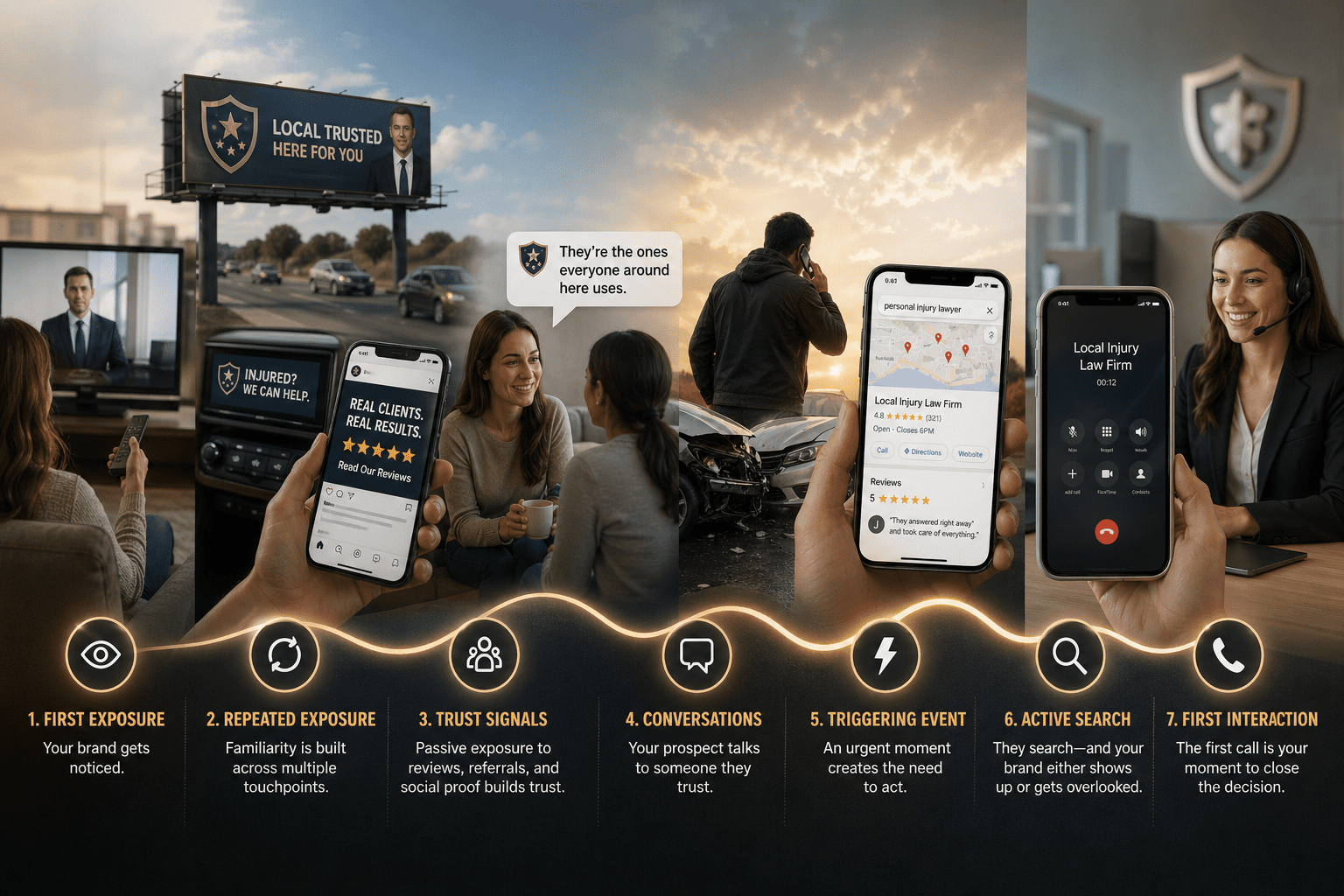
The window between a prospect’s first exposure to your law firm’s brand and the moment they act is not empty space. It is the most consequential stretch of the entire marketing effort – and most marketing and media plans say almost nothing about it. Here’s what happens, or should happen, in that window between first exposure and action:
- Familiarity Gets Built Through Repetition Across Multiple Touchpoints The first exposure rarely does anything on its own, except to begin a process of recognition. Your prospect sees a TV spot. Then they pass a billboard. Then they hear a radio ad. Then they see a social post. None of those individually triggers a decision – but together, over time, they deposit something in the brain. Your brand starts to feel known, and that feeling of familiarity is what the brain reaches for under stress. Your media plan must be designed with enough consistency in message, look, and voice that each exposure reinforces the same impression rather than starting over.
- Trust Signals Get Encountered Passively Between first exposure and decision, people absorb social proof without actively looking for it. They see a review mentioned in a social ad. A friend references a brand in conversation. They notice the billboard every morning on the commute and unconsciously register that this brand has staying power. None of this is active research – it’s ambient accumulation. Your media plan should be placing trust signals where the prospect will encounter them naturally and repeatedly, not just at the moment they go looking.
- Your Prospect Has a Conversation with Someone They Trust This almost always happens and almost never gets planned for. Before acting, most people – especially in high-stakes decisions – talk to a spouse, a friend, a family member, or a colleague. That conversation is a critical moment in the window. The question is whether your law firm has enough presence and distinctiveness that the prospect can describe it accurately and confidently to that person. If your firm’s message is vague or generic, it won’t survive the retelling. If it’s clear and specific – “they’re the ones who answer live, any time” or “they’re the ones everyone around here uses” – it gets reinforced rather than lost.
- A Triggering Event Collapses the Window At some point something happens that moves your prospect from passive familiarity to active urgency. The accident. The diagnosis. That trigger is the moment everything your brand has deposited in the previous weeks or months either pays off or doesn’t. If your brand has built enough familiarity, your prospect doesn’t start from scratch – they already know where they’re going. If it hasn’t, your prospect enters a search and comparison process where your brand is competing on equal footing with your competition. Your media plan’s job is to make sure that when the trigger fires, your brand is already positioned as the obvious first call.
- Active Search Happens – and Your Brand Either Shows Up or Loses Once urgency hits, your prospect grabs their phone. They search. They scroll. They look at maps. They check reviews. This is the moment where offline brand building and online presence must work together seamlessly. A brand that built familiarity through TV and outdoor but has weak search presence, thin reviews, or a slow website loses the decision right here despite everything it spent to get to this point. Your plan must ensure that when the active search moment arrives, your brand’s digital presence matches and confirms the impression that was built passively. The two must reinforce each other or the whole system leaks.
- The First Interaction Either Closes or Loses the Decision If your firm’s prospects get through search and make contact, your plan’s work is almost done – but not quite. That first call, text, or form response is the final handoff from media to reality. If the response is fast, human, calm, and confident, the brand delivers on everything the media promised. If it’s slow, generic, or impersonal, all the investment in building familiarity and trust collapses in the last ten seconds. This is why Roux treats intake speed and first-call quality as part of the media system, not separate from it.
Is your firm’s marketing making the most of the critical window between first exposure and the decision moment? Most brands aren’t. They’re spending heavily at both ends and leaving the middle — where decisions are made — almost entirely unaddressed. That’s the problem Roux Advertising solves. Call 504-561-5055 or email eric@rouxadvertising.com.
About the Author
 Roux Advertising
Eric Morgan is the President of Roux Advertising and helps law firms solve marketing problems by attracting the right clients using data-driven strategies – customized, predictable, profitable. He can be reached at eric@rouxadvertising.com. Visit www.rouxadvertising.com to learn more.
